
If you’ve been running consistently for a while, can easily run 30-60 minutes continuously, and you are interested in 80/20 training, I would recommend that you do a 30-minute field test to determine your lactate threshold heart rate.
What is a 30-minute field test?
This test was developed by Joe Friel, author of Total Heartrate Training. It’s a simple (albeit torturous) way to determine your lactate threshold heartrate (LTHR) so you can calculate your heartrate zones. It requires a device that can record your pace and HR.
Warm-up for 10 minutes and do 4-6 x 20 second strides. Strides are short sprints where you accelerate to your top speed for 20 seconds and walk or jog back to recover. Take a brief 1-2 minute rest after the strides and begin the test. Run all out for 30 minutes. Try to run it with a consistent pace. Don’t go out too fast and die off toward the end. After the 30 minute effort, be sure to cool down for 10 minutes to gradually bring down your heart rate.
Your average heart rate for the last 20 minutes of that 30-minute all out run is your lactate threshold heart rate (LTHR). So set your watch for a 30 minute run with splits at 10min and 20min so you can see the average HR for each segment.
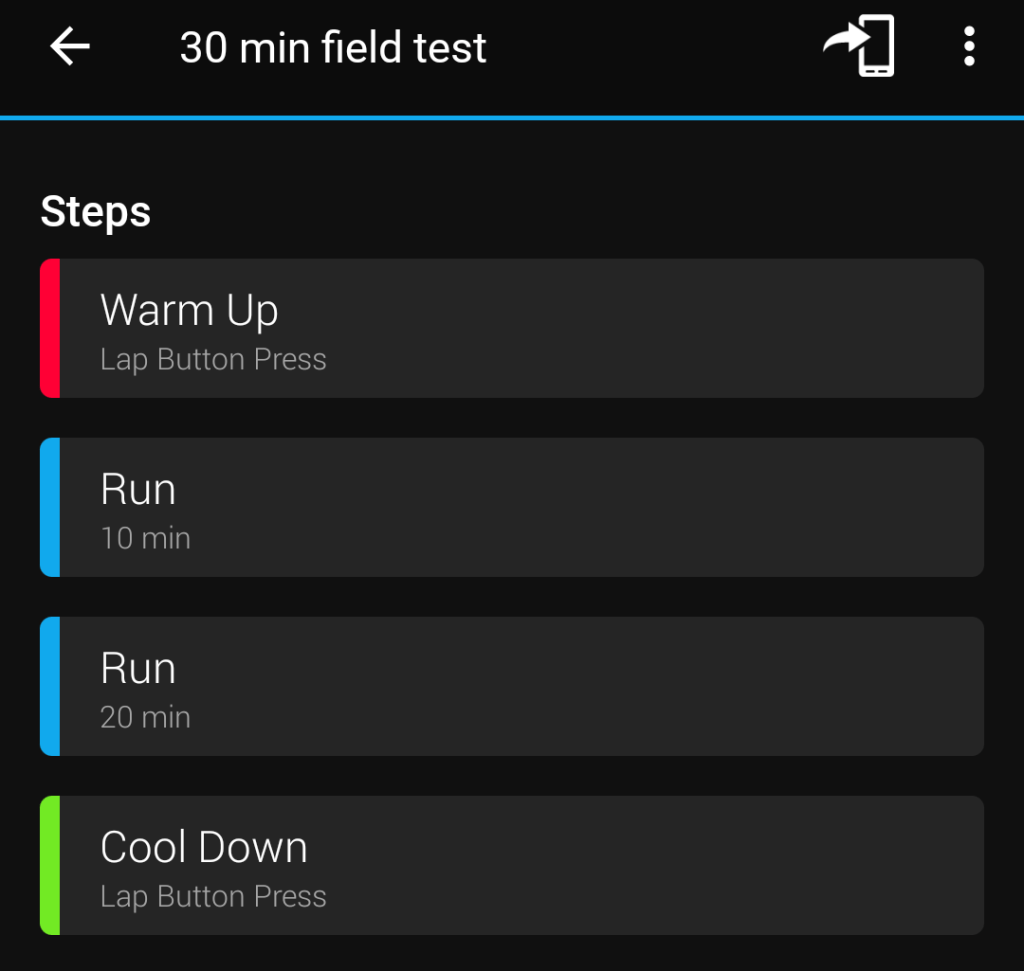
Ideally, do this as a solo run on a track where you can run non-stop on a flat terrain. Don’t drink caffeine before the test since that may interfere with your HR.
Why do I need to know my LTHR?
With polarized 80/20 training, 80% of your training should be run at an easy effort and 20% of your training should be run at a hard effort. However, most people run their easy runs too hard and their hard runs too easy so how do you know what’s easy and what’s hard? There are a number of ways to measure effort: Rate of Perceived Exersion (RPE), pace, power, and heart rate. There are pros and cons for each method. Some say RPE is the best metric but it can be difficult to know your RPE. Pace requires frequent field tests as you improve and power requires a power meter which can be expensive.
Heart rate is a common way to determine effort and there are many ways to determine your heart rate zones. The most accurate way is to get it measured at a lab but it might be expensive and difficult to access for the average runner. Another way is by using the max HR formula of 220-age. Unfortunately, this formula has a huge margin of error and is wrong for most people. There are other formulas that use both max HR and resting HR but if max HR is wrong, the result is still going to be wrong. The 30-minute field test is an effective way to determine your HR zones. All you need is a device that can measure hr and go for a 30-minute all out run!
How do I calculate my zones using LTHR?
A 30-minute field test, if done properly, will give you a good idea of your lactate threshold heartrate. You’ll be able to calculate all your zones with this number which will be more accurate than using the max HR formula. If you are using a Garmin, you can use the LTHR method to set your zones:
- Zone 1: <80% LTHR
- Zone 2: 80-89% LTHR
- Zone 3: 90-94% LTHR
- Zone 4: 95-99% LTHR
- Zone 5: 100-110% LTHR
What zone should I run in?
- Zone 1 and 2 is where you want to do 80% of your training. Most easy and long runs should fall into these zones.
- Zone 4 and 5 is where you want to do 20% of your training. Most tempo or speed workouts should fall into these zones.
- Zone 3 is typically your natural pace. It’s not hard enough to be a hard workout but not easy enough to be an easy run. Unless you are doing half marathon or marathon race pace training, you’ll want to avoid running in this zone.
Hope this helps you understand why and how to do a 30 minute field test. Please note this test should only be performed if you are already able to run 30-60 minutes consistently.
Have fun!
 joysofrunning